Is Semax FDA approved?
No. This profile records Semax as not FDA approved and for research use only.
MORE CONTEXT ›
Review the regulatory and source details on this page for the current context.
 Start Free Trial
THE FOCUS ENHANCER
ACTH(4-10) Analog; N-Acetyl Semax
Semax is a brain-derived peptide that sharpens focus, memory, and learning and builds stress resilience by supporting BDNF and protecting neurons. It's often used for cognitive performance and recovery.
Not FDA approved · research use only
Reviewed by our clinical team
4 research sources
Aug 28, 2026
Dose and schedule recommendations shown below come from The Peptide App Clinical Team. Research links are provided so readers can inspect the supporting evidence directly. Review the sources.
No. This profile records Semax as not FDA approved and for research use only.
Review the regulatory and source details on this page for the current context.
Dose: Intranasal (start here): 200-300 mcg per dose, 1-3x daily.
Begin at 200 mcg once daily and increase only as needed; max ~900-1,000 mcg/day. Subcutaneous: begin at 50-100 mcg once daily, increase in 100 mcg steps only as needed; max ~600 mcg/day.. Schedule: daily. Cycle: 10-14 days on, 20+ days off. This is clinical-team guidance for reference and does not replace individualized instructions from a licensed clinician.
This guide links to 4 curated or current research sources.
Open the research section to inspect the source titles, publication details, study types, and available abstracts directly.
Dramatically increases brain-derived neurotrophic factor
Semax appears to raise levels of BDNF, a growth factor that helps neurons survive, form new connections, and strengthen existing ones. In animal studies it drives up BDNF expression in the hippocampus, a region tied to learning and memory, which is thought to underlie its nootropic and recovery effects. Keep in mind this evidence is largely preclinical, and Semax is not FDA-approved. The size of the effect in people, and how it translates to everyday cognition, is still being worked out.
Modulates monoamine turnover for mood and focus
Semax is thought to shift the turnover of dopamine and serotonin, the monoamines most tied to motivation, mood, and sustained attention. Rather than flooding the brain with these chemicals, it appears to nudge how quickly they are made and broken down, which is the proposed basis for its reported focus and mood effects. This mechanism rests mostly on preclinical animal work, and Semax is not FDA-approved for any use. Treat the mood and focus claims as early-stage rather than established.
Reduces oxidative stress and inflammatory cytokines
Under stress or reduced blood flow, brain tissue is damaged by oxidative stress and a surge of inflammatory signaling molecules called cytokines. Semax is reported to blunt both, which is why it has been studied as a protective agent in settings like ischemic stroke where that damage cascade is central. This is one of its better-studied uses, though most mechanistic detail still comes from animal and early clinical work, and it is not FDA-approved. The protection is about limiting injury, not reversing it.
Inhibits peptidases to maintain natural opioids
Enkephalins are your body's own short-lived opioid-like peptides, and they are normally broken down quickly by enzymes called peptidases. Semax is reported to slow that breakdown, letting natural enkephalins linger longer and extend their signaling. This mechanism comes from preclinical research, and Semax is not FDA-approved. What it means for pain, mood, or stress in people is not yet well established.
Semax is a synthetic heptapeptide with the sequence Met-Glu-His-Phe-Pro-Gly-Pro. Its front end mirrors the ACTH(4-7) fragment of adrenocorticotropic hormone, and a stabilizing Pro-Gly-Pro tail is attached to the end, which is why it is often described loosely as an ACTH(4-10) analog. It was developed in the 1980s at the Institute of Molecular Genetics of the Russian Academy of Sciences, associated with the groups of Ivan Ashmarin and Nikolai Myasoedov. Although it borrows a piece of a stress hormone, the added tail strips away the corticotropic, hormone-releasing activity, leaving a compound studied mainly for effects on the brain rather than the adrenal glands. In Russia it moved into clinical use for stroke, transient ischemic attack, and cognitive disorders, and it later spread through the wider nootropic community as a research-only peptide.
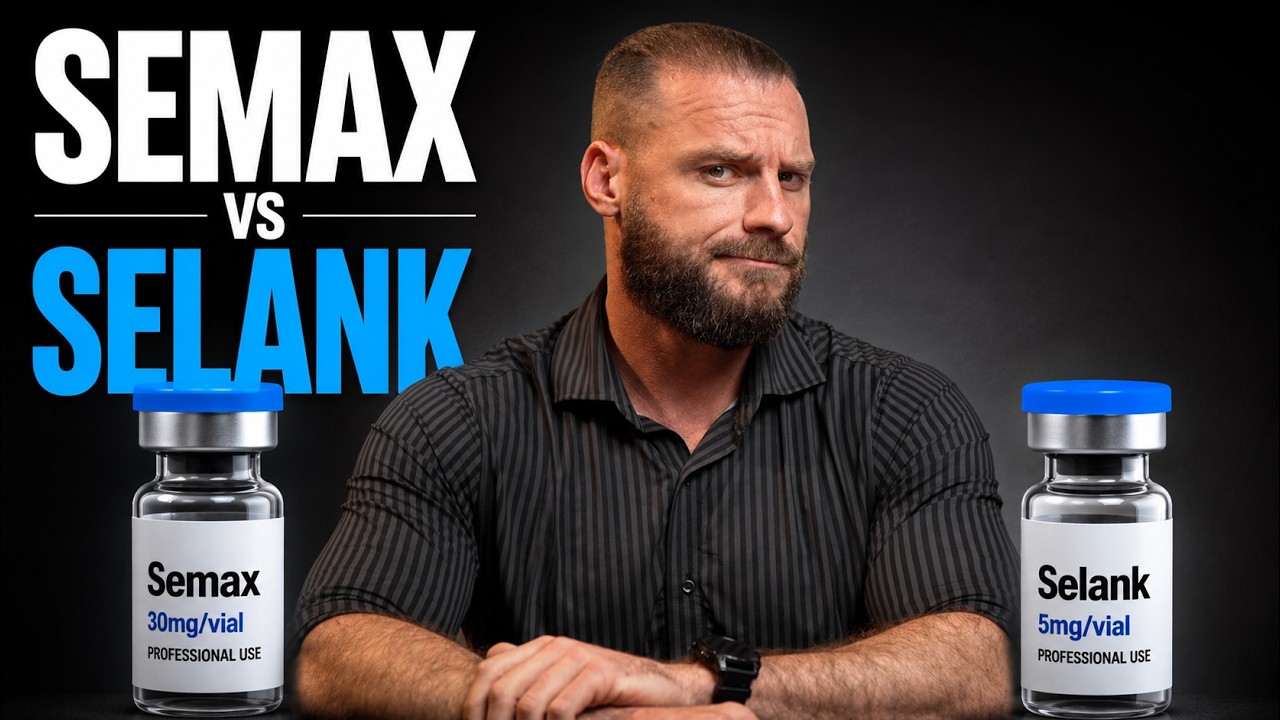
The most common reason people look into Semax is cognitive performance, with users reporting sharper focus, better memory and recall, and reduced mental fatigue or brain fog. Its original clinical context was neuroprotection and recovery, so it has been studied and used in Russia around ischemic stroke, transient ischemic attack, and traumatic brain injury. Because it is reported to nudge dopamine and serotonin signaling, some people also reach for it for mood, motivation, and a sense of calm alertness without the jitteriness of stimulants. Less mainstream uses discussed by clinicians include ADHD support, chronic fatigue, and optic nerve conditions, though evidence for these is thinner. It is frequently stacked with Selank, a related Russian anxiolytic peptide, with the pairing framed as focus plus a calmer baseline.
Semax is best known for raising brain-derived neurotrophic factor, or BDNF, a signaling protein tied to neuron growth, survival, and plasticity, and it appears to increase expression of BDNF and its receptor in brain regions such as the hippocampus and hypothalamus. Beyond that, it is described as modulating dopaminergic and serotonergic systems, which fits its reported effects on focus and mood. Clinicians also point to secondary actions including improved cerebral blood flow and antioxidant, anti-inflammatory protection of neural tissue. It is thought to interact with melanocortin receptors, possibly as a partial agonist or antagonist, and to inhibit enkephalin-degrading enzymes, which would prolong the action of the body’s own regulatory peptides. What makes it unusual is this layered, multi-target profile from a very small molecule, though the precise contribution of each pathway in humans is not fully pinned down.
Semax is most often used intranasally as drops or a spray, which is the route tied to its Russian clinical history and which places it close to the brain. Subcutaneous injection is the other route people describe, and it is generally less popular than the nasal form. Reported protocols frame it as a fairly short-acting compound, with some users noting effects within roughly fifteen to thirty minutes of a nasal dose and repeating it once to several times across a day depending on the person. Because tolerance to receptor-active compounds can build, commentators often describe cycling patterns such as several days on followed by a break, rather than continuous long-term use. These dosing patterns are description, not medical guidance, and clinicians stress that intranasal delivery near the brain makes product sourcing and purity an especially serious concern.
The great majority of Semax research is Russian, spanning animal models and clinical use, and much of it centers on ischemic stroke, brain injury, and cognitive impairment rather than healthy-brain enhancement. Mechanistic work supporting the BDNF and neurotrophin story is reasonably developed in animal studies, but rigorous, independent Western clinical trials are limited. Educators reviewing the compound repeatedly note that the human evidence, especially for the everyday focus and productivity use that drives its popularity, is thinner than the enthusiasm around it. Reported tolerability is good, with both Semax and its common partner Selank described as well tolerated and low in side effects in the available data. It is an intriguing, plausibly neuroprotective peptide whose strongest evidence sits in a specific clinical setting concentrated in one country, and whose nootropic reputation rests heavily on user reports.
Semax is approved and marketed as a medicine in Russia, where it is used clinically and appears on the country’s list of essential drugs. It is not approved by the FDA in the United States, and it is not an established pharmaceutical in most Western markets, so it typically circulates as a research-only chemical sold for laboratory use rather than as a licensed drug. That research-only framing is exactly why clinicians caution against buying and self-administering it, and why sourcing and purity are recurring worries given the intranasal route. It is sometimes encountered under names or codes tied to its ACTH-fragment origin, and its close relative Selank is often discussed alongside it.
 NO. 01
 NO. 02
 NO. 03
The live research feed did not return papers for this page. The curated references below remain available for crawlable source context.