Is DSIP FDA approved?
No. This profile records DSIP as not FDA approved and for research use only.
MORE CONTEXT ›
Review the regulatory and source details on this page for the current context.
 Start Free Trial
THE SLEEP INDUCER
Delta Sleep-Inducing Peptide
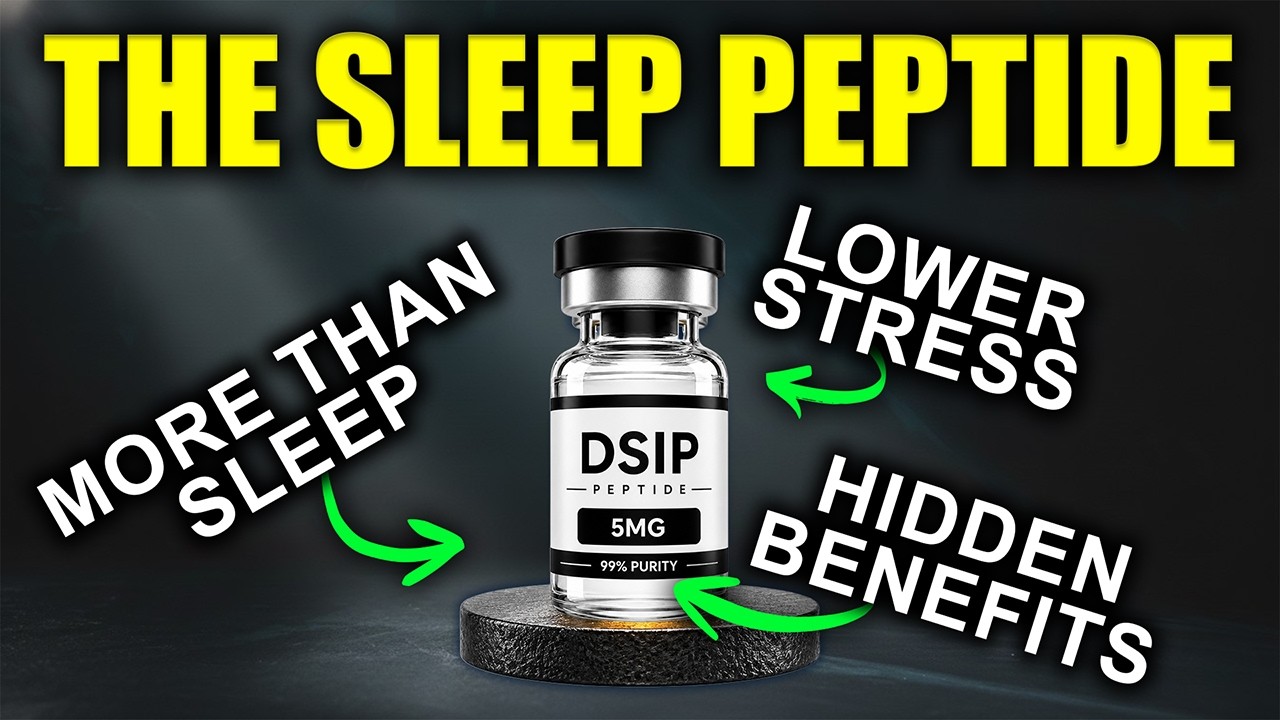
DSIP (Delta Sleep-Inducing Peptide) is a nine-amino-acid peptide naturally found in your hypothalamus. It promotes deep, restorative delta-wave sleep, reduces pain perception, helps manage stress hormones, and can even assist with withdrawal symptoms. It works with your body's natural sleep systems rather than forcing sedation.
Not FDA approved · research use only
Reviewed by our clinical team
3 research sources
Aug 28, 2026
Dose and schedule recommendations shown below come from The Peptide App Clinical Team. Research links are provided so readers can inspect the supporting evidence directly. Review the sources.
No. This profile records DSIP as not FDA approved and for research use only.
Review the regulatory and source details on this page for the current context.
Dose: 100 mcg every 2-3 days (subcutaneous or IV).
Schedule: daily. Cycle: As needed for sleep support. This is clinical-team guidance for reference and does not replace individualized instructions from a licensed clinician.
This guide links to 3 curated or current research sources.
Open the research section to inspect the source titles, publication details, study types, and available abstracts directly.
Increases deep, restorative delta-wave sleep
DSIP was first isolated because infusing it appeared to shift brain activity toward the slow, high-amplitude delta waves that mark the deepest stage of sleep, which is when the body does most of its physical repair. The idea is that it nudges the sleep-regulating circuitry rather than sedating you the way a sleeping pill does, so any added deep sleep comes from your own rhythm. The honest picture is that this is early-stage, mostly older animal and small human work, and results have been inconsistent, so it should be read as a plausible direction rather than a settled effect.
Enhances endogenous opioid peptides for natural pain relief
Rather than acting as a painkiller itself, DSIP is thought to influence the body's own opioid peptide systems, the endorphin-like signals that dampen pain naturally. By modulating that endogenous machinery it may raise the threshold at which discomfort registers, which is a different route than blocking pain receptors directly. This is preclinical and early clinical territory, so treat it as an exploratory mechanism, not an established analgesic.
Modulates cortisol and other stress hormones
DSIP appears to act on the brain's stress-axis control rather than a single gland, which is why it is described as balancing cortisol and related stress hormones toward a more even baseline instead of simply lowering them. The practical logic is that steadier stress-hormone rhythms tend to travel alongside better sleep and recovery, so the two effects may reinforce each other. Evidence here is limited and mostly early-stage, so this is best understood as a modulating tendency observed in small studies, not a reliable hormonal treatment.
Stabilizes dopamine and serotonin signaling
Beyond sleep, DSIP has been reported to interact with the neurotransmitter systems that shape mood and drive, with a stabilizing rather than stimulating character on dopamine and serotonin signaling. The intent of that framing is smoothing over-activity or swings toward a steadier tone, which fits its broader profile as a regulator rather than a booster. This is one of the least-established of its proposed actions and rests on early experimental work, so it should be read cautiously.
DSIP is a small naturally occurring peptide, a nonapeptide made of nine amino acids with the sequence Trp-Ala-Gly-Gly-Asp-Ala-Ser-Gly-Glu. It was first described in 1977 by the Swiss researchers Guido Schoenenberger and Marcel Monnier at the University of Basel, who were running cross-circulation experiments in rabbits. When they took blood from the brain of rabbits that had been electrically nudged into sleep and infused a dialyzed fraction of it into awake rabbits, the recipients showed more of the slow delta-wave EEG activity that marks deep sleep, and the peptide responsible was named for that effect. It is found naturally in the brain and elsewhere in the body, but decades later its normal physiological role is still not settled. That early rabbit work is the reason DSIP has been studied for sleep at all, and much of the foundational research traces back to a small circle of labs rather than a broad field.
The headline reason people look into DSIP is sleep, and specifically the depth or quality of sleep rather than simply the number of hours in bed. Creators who discuss it, including Jacob Nachinson and Hunter Williams, tend to frame it as something that helps a person hold on to deep, restorative sleep rather than something that knocks you out at bedtime, so it is often described as more useful for staying asleep and reaching slow-wave sleep than for initial drowsiness. Beyond sleep, the older literature also explored DSIP for stress and cortisol regulation, for chronic pain, and as an aid for people coming off opioids or alcohol. In peptide-community stacks it is sometimes paired with growth-hormone secretagogues such as CJC-1295, ipamorelin, or tesamorelin, on the logic that those target the growth-hormone rhythm while DSIP is aimed at sleep architecture directly. It is generally talked about as a short-term tool for a rough patch rather than something to run indefinitely.
The unusual thing about DSIP is that it carries a very specific name, delta sleep-inducing peptide, yet its mechanism has never been cleanly pinned down. A widely cited 2006 review by Kovalzon literally called it a still unresolved riddle, noting that it does not behave like a reliable, dedicated sleep switch. What researchers can say is that it appears to influence neurotransmitter signaling and the body’s own internal opioid system, and to touch the stress axis that governs cortisol and the fight-or-flight response. Interacting with the internal opioid system does not make it an opioid drug, and in fact it was studied as an aid for withdrawal rather than as something habit-forming. The distinctive framing you hear from clinicians like Dr. Jones is that DSIP is not sedation, it seems to work with the brain’s own machinery to deepen sleep, though the exact receptors it acts on remain unmapped.
In the original human studies DSIP was usually given intravenously, which is not how it circulates in today’s peptide community. There it is typically discussed as a subcutaneous injection, and some people describe intranasal use, with dosing generally timed to the evening or shortly before bed to line up with the target of deeper night-time sleep. The peptide is short-acting, so the framing is about supporting a single night rather than building a long steady blood level. Commentators repeatedly stress running it as a short cycle, on the order of a couple of weeks to a month or two, largely because long-term data simply does not exist. That is how people report using it, and the timing and route questions are exactly the ones a knowledgeable clinician would weigh case by case.
The live research feed did not return papers for this page. The curated references below remain available for crawlable source context.