
BPC-157
THE HEALER
Body Protection Compound-157
BPC-157 is a stomach-derived peptide that signals tissue to heal faster, especially tendons, ligaments, nerves, and the gut lining, by boosting repair factors and protecting against inflammation and stress.
BPC-157 Evidence Snapshot
How these guides are reviewedNot FDA approved · research use only
Reviewed by our clinical team
9 research sources
Jul 15, 2026
Dose and schedule recommendations shown below come from The Peptide App Clinical Team. Research links are provided so readers can inspect the supporting evidence directly. Review the sources.
Studied Effects & Mechanisms
Blood Vessel Growth
Creates new blood vessels to deliver nutrients to damaged tissue
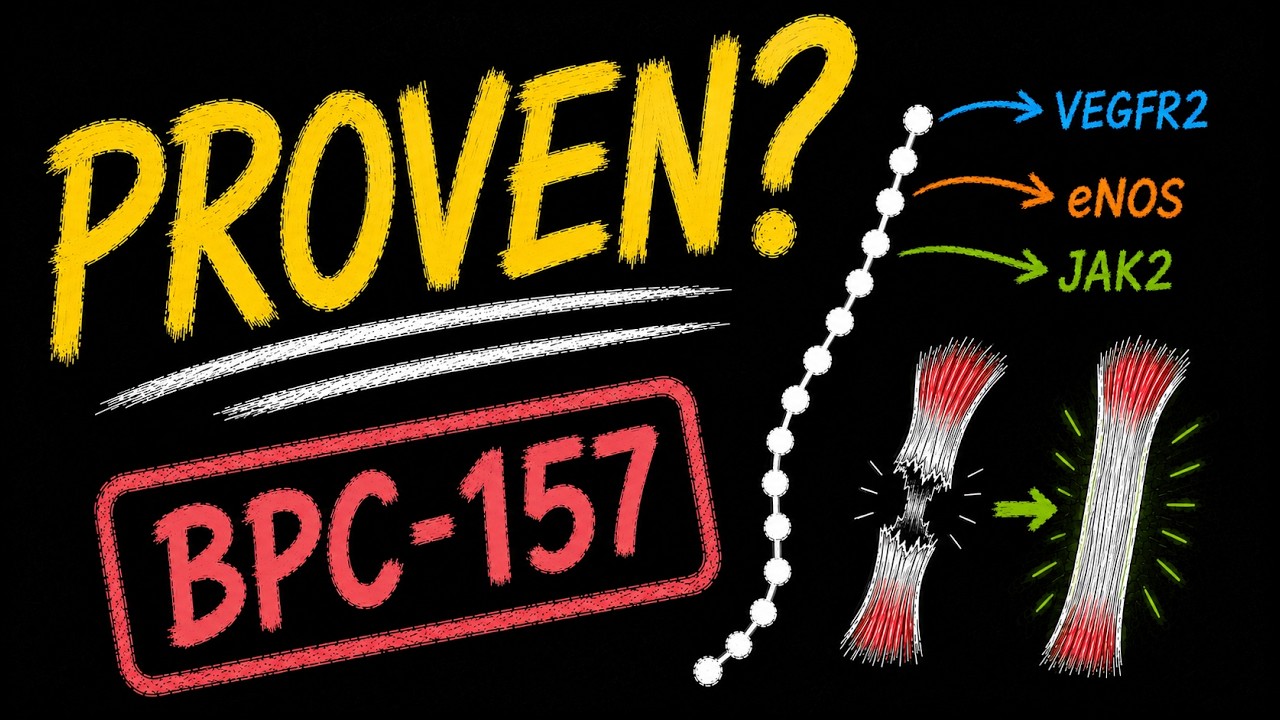
BPC-157 upregulates VEGFR2, the receptor that triggers new blood vessel formation, and works through the nitric-oxide pathway your body uses to widen vessels and regulate blood flow. In animal studies this routes a fresh blood supply into injured tendon and ligament tissue, which normally heals slowly precisely because it is so poorly vascularized to begin with. This evidence is largely preclinical; controlled human trials are still lacking.
Anti-Inflammatory
Calms down swelling and pain signals
Rather than broadly suppressing the immune system, BPC-157 appears to rebalance it, dialing down pro-inflammatory signals like TNF-alpha while leaving the repair-side response intact. In injury models this shows up as less swelling without the healing delay that comes from blocking inflammation outright, which may be why users often report pain easing before the tissue has fully recovered. The evidence to date is largely from animal research.
Tissue Repair
Speeds up collagen production and cell regeneration
BPC-157 stimulates fibroblasts, the cells that lay down collagen, and speeds their migration into a wound, accelerating how quickly the matrix that holds tissue together is rebuilt. Animal work has shown improved healing of tendon, muscle, and even tendon-to-bone junctions, some of the hardest tissues in the body to repair. As with its other effects, the strong results are preclinical and have not yet been confirmed in human trials.
Gut-Brain Connection
Helps heal the gut lining and supports neurotransmitter balance
Named for the peptide's origin in gastric juice, this reflects BPC-157's protective effect on the gut lining and its role in the gut-brain axis, the two-way signaling between your digestive tract and nervous system. Research suggests it stabilizes the intestinal barrier and interacts with the serotonin and dopamine systems, part of why it is studied for both gut and mood-related applications. These findings are early and mostly animal-based.
BPC stands for Body Protection Compound. It was isolated by a research group in Croatia in the 1990s. The body does not make BPC-157 on its own. It makes a much larger protein found in gastric juice, and BPC-157 is a 15-amino-acid fragment of that parent protein. Interest in gut-derived healing compounds is old: the same Pavlov known for his work with dogs also studied gastric juice as a medicine for digestive complaints. BPC-157 was first explored as a treatment for the gut, and its reputation for tendon and muscle repair came later.
BPC-157 is best known online for tendon, ligament, and muscle recovery, but a lot of the research interest sits in the gut, where it was first studied. People also read about it for general digestive comfort. There is early interest in effects on the gut-brain axis as well, including reports around cravings and mood, though that area is far less studied than its repair effects.
A few things set BPC-157 apart. It has no known receptor, so researchers think it may work by adjusting proteins the body already makes rather than by hitting a single target. It appears to promote repair rather than simply block inflammation, often described as pressing the gas pedal on the body’s own healing. In one tendon model it increased the number of growth-hormone receptors on the tissue, which could help the tendon respond to growth signals. In animal studies it also supported healing even when corticosteroids, which usually slow healing, were given at the same time.
BPC-157 is taken either by injection or orally, and the difference matters more than it might seem. Taken orally, it has generally not been detectable in the bloodstream, which suggests it may act locally in the gut rather than travel through the body. Injected BPC-157 does reach the wider system. This is why oral forms are usually associated with gut goals and injectable forms with tendon or muscle goals. This is background, not a recommendation.
One of the odder corners of the BPC-157 literature has nothing to do with tendons. In the mid 2000s the same Croatian group ran a series of experiments on alcohol. In one, mice were given a dose of ethanol high enough to put them fully under: no righting reflex, no reaction to handling, body temperature dropping, and a quarter of the animals did not survive it. The mice given BPC-157 came around faster. A companion study looked at withdrawal instead, and after thirteen days of drinking, animals taken off alcohol abruptly had fewer and milder seizures when given the peptide. Separate rat work found it protected the stomach lining against alcohol damage, which sits much closer to what BPC-157 was originally studied for.
You will see this cited as a hangover fix. It is all rodents, and none of it studied a hangover, which is a different next day problem nobody has put the compound up against. Like most of the BPC-157 literature, it also traces back to one research group. A real and genuinely strange line of research, then, but not a reason to expect anything on a Sunday morning. Fun to know rather than known.
BPC-157 has a long research history, and its tolerability record is a standout. In animal studies no lethal dose has been found even at very high amounts, and it is widely regarded as one of the most well tolerated peptides. Most of the research is in animals, and a large share of that work traces to a single Croatian research group, with some replication by others. Formal human trials are still limited, the main example being a small set of early trials using BPC-157 for a gut condition. That adds up to a compound with an excellent tolerability record and a deep body of animal data, alongside a small amount of formal human research.
BPC-157 has not been approved by the FDA. In late 2024 it was placed on an FDA list that restricts pharmacy compounding, alongside a number of other peptides. It is sometimes sold under the name PDA, short for pentadecapeptide arginate, which is the same compound in a different salt form. It also appears on anti-doping watch lists, so athletes in tested sports should be aware of it.
Further listening
4 recordings NO. 01
 NO. 02
 NO. 03
 NO. 04
BPC-157 Research
Live research temporarily unavailableThe live research feed did not return papers for this page. The curated references below remain available for crawlable source context.