Is Selank FDA approved?
No. This profile records Selank as not FDA approved and for research use only.
MORE CONTEXT ›
Review the regulatory and source details on this page for the current context.
 Start Free Trial
THE ANXIETY REDUCER
TP-7; N-acetyl Selank Amidate
Selank is an anxiety-reducing peptide that modulates GABA and the brain's immune signaling to calm the mind without sedation, while supporting focus and steady mood.
Not FDA approved · research use only
Reviewed by our clinical team
2 research sources
Aug 28, 2026
Dose and schedule recommendations shown below come from The Peptide App Clinical Team. Research links are provided so readers can inspect the supporting evidence directly. Review the sources.
No. This profile records Selank as not FDA approved and for research use only.
Review the regulatory and source details on this page for the current context.
Dose: 400-600 mcg per nostril, 2-3 times daily (intranasal) OR 300-1000 mcg daily (subcutaneous).
Schedule: daily. Cycle: 6 weeks on, 6 weeks off. This is clinical-team guidance for reference and does not replace individualized instructions from a licensed clinician.
This guide links to 2 curated or current research sources.
Open the research section to inspect the source titles, publication details, study types, and available abstracts directly.
Increases GABA-A receptor affinity for calming
GABA is the brain's main calming signal, and Selank is thought to make GABA-A receptors more responsive to it rather than adding a sedative of its own. By raising the receptors' sensitivity, the same amount of GABA produces more of a quieting effect, which is the proposed basis for its calm-without-heavy-sedation profile. This mechanism comes mostly from early Russian and preclinical work, so treat it as a plausible model rather than a settled, widely replicated finding.
Activates ERK/PI3K/Akt for neurogenesis
BDNF is a growth factor that helps neurons survive, form new connections, and support new-cell formation, and it works through intracellular cascades like ERK and PI3K/Akt. The idea here is that Selank nudges these signaling pathways, which in turn raises BDNF-related activity linked to neuroplasticity. This is early-stage, largely animal and cell-level evidence, so the neurogenesis angle is a research signal rather than a proven human outcome.
Inhibits enkephalinase to maintain endogenous opioids
Enkephalins are your body's own opioid-like peptides, and an enzyme called enkephalinase normally breaks them down quickly. By slowing that breakdown, Selank is proposed to let your natural enkephalins linger longer, which may extend their effects on mood and stress. This is a preclinical mechanism, so think of it as how the peptide is believed to act rather than a confirmed clinical result.
Shifts cytokines toward anti-inflammatory IL-10
Selank descends from tuftsin, a naturally immune-active peptide, and is thought to shift the balance of signaling molecules called cytokines toward anti-inflammatory ones like IL-10. Tilting that balance away from pro-inflammatory signals is the proposed way it may calm low-grade immune activation. The evidence is preclinical and early, so this immune-modulating effect is best read as a research finding, not an established therapeutic use.
Selank is a synthetic heptapeptide, meaning a chain of seven amino acids, developed in the 1980s and 1990s at the Institute of Molecular Genetics of the Russian Academy of Sciences. It was designed as a more stable version of tuftsin, a naturally occurring four amino acid fragment that is cleaved from immunoglobulin G, the most common antibody in human blood. Because tuftsin normally helps regulate the immune response, its creators added three extra amino acids to slow the molecule’s breakdown, and the resulting peptide still carries the full tuftsin sequence and some of its immune activity. On the strength of Russian animal and human studies, Selank was approved in Russia as a prescription anxiety drug in 2009 and reclassified for over the counter sale in 2017. It also appears on Russia’s official list of vital and essential medicines, yet it remains largely unknown and unapproved in the West.
The main reason people look into Selank is anxiety. In its home market it is positioned as an alternative to benzodiazepines such as Xanax or Ativan, and Russian trials reported reductions in generalized anxiety and in adjustment disorder, where someone reacts to a stressor out of proportion. A second draw is cognition, with users reporting steadier focus and mental clarity rather than sedation, which is part of why some pair it with Semax, a related Russian nootropic peptide, for a mood and focus stack. Because it descends from the immune fragment tuftsin, it is also discussed for immune modulation and for gut related effects, though these uses rest on much thinner evidence. In fitness and biohacking circles it is often framed more loosely as a tool for social confidence and reduced anticipatory anxiety, a framing that is largely anecdotal.
What sets Selank apart is that it appears to calm anxiety through the same GABA system as benzodiazepines without behaving like one. GABA is the brain’s primary inhibitory, or calming, signal, and Russian studies describe Selank as helping GABA bind its GABA-A receptor, which is thought to be its chief anti-anxiety action. Reviewers note it also touches the glutamate system, which acts more like the brain’s accelerator, and that it helps balance monoamine neurotransmitters such as serotonin, norepinephrine, and dopamine, all of which are tied to anxiety and mood. At least one rat study found it influenced BDNF, a protein important for brain plasticity and the growth of new neurons. The distinctive part is what the trials did not find: unlike benzodiazepines, Selank was reported to ease anxiety without the heavy sedation, cognitive dulling, or physical dependence that those drugs can cause after even a month of use.
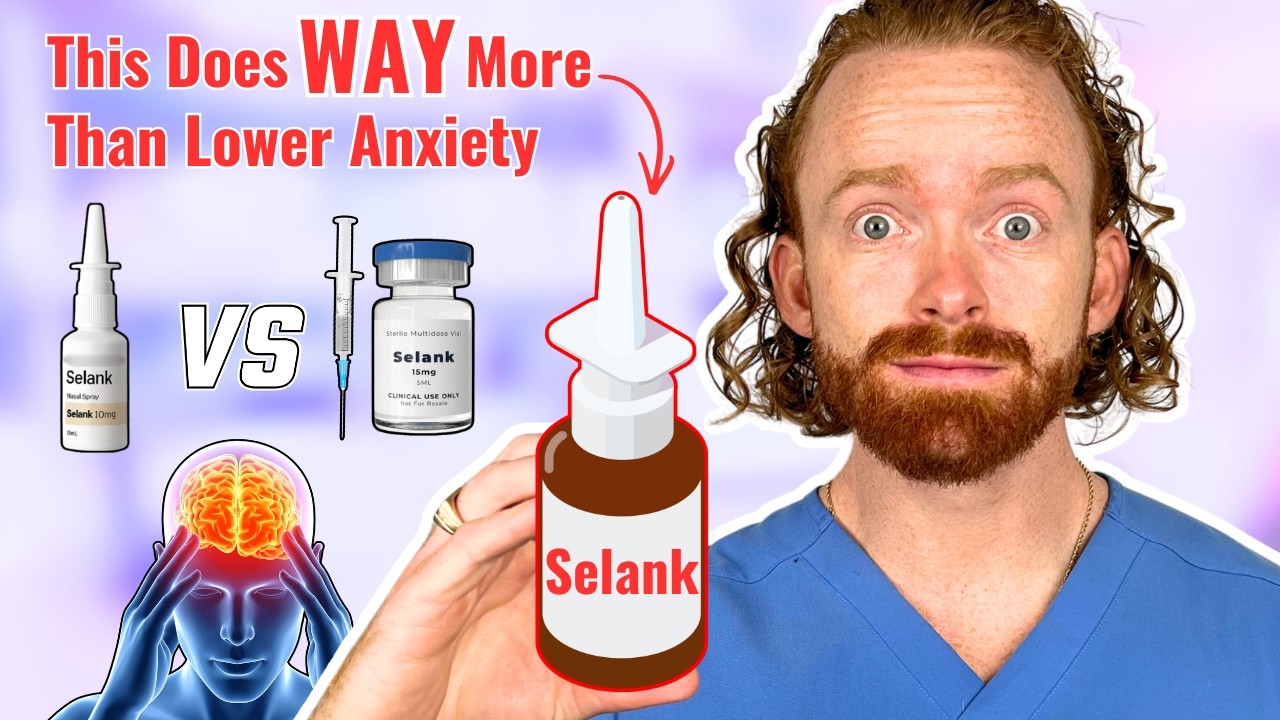
Selank is used in two main forms, an intranasal spray or drops and subcutaneous injection. The nasal route is the traditional one and is how the approved Russian product is delivered, which appeals to people who prefer to avoid needles. There is some debate about how much of an intranasal dose actually reaches the bloodstream, though the extra amino acids that make Selank more stable than tuftsin may also protect it from being broken down in the nasal cavity, allowing some systemic absorption. Selank is metabolized quickly and has a very short half-life in the blood, so reported protocols tend to describe frequent dosing, sometimes several administrations across the day, with the assumption that its effects on the brain outlast its brief window in plasma. That is what users report doing, not guidance to do the same.
Selank is approved in Russia but poorly proven by Western standards. The publicly available human trials are small, with none appearing to exceed roughly 70 participants, and many are not blinded, not well randomized, and often not placebo controlled. Russia’s regulatory framework leans more on smaller studies, biological plausibility, and anecdotal experience than on the large phase three randomized controlled trials that the FDA and EU require, which is how Selank cleared approval there but nowhere near enough to clear it here. Some findings are genuinely interesting, such as the reported anxiety reduction comparable to benzodiazepines without their side effect profile, but several key claims, including certain immune, gut, and BDNF effects, trace to single studies or to animal work. Much of the supporting literature also originates from the same Russian research community that developed the peptide, so independent replication is limited and confidence in the conclusions, especially on long term safety, should stay modest.
Selank is not approved by the FDA and is not an approved drug in the United States or the European Union, where it is typically sold only as a research chemical rather than a medicine. In Russia it is a fully approved product, available over the counter since 2017 and listed among the country’s vital and essential medicines, which is a sharp contrast to its unregulated status elsewhere. Material bought outside Russia is not manufactured or verified to pharmaceutical standards, so identity, purity, and dose can vary between suppliers. It is sometimes discussed alongside its sister peptide Semax, which sits in the same Russian-approved, Western-unapproved category.
The live research feed did not return papers for this page. The curated references below remain available for crawlable source context.