
Start with the exact compound and product. Check its category, strongest matching human evidence, and lot-specific documents. Use a calculator only after the inputs are confirmed, and take any remaining questions to a licensed clinician or pharmacist.
Just heard
about one?
Choose the name you know. The next page applies the claim, category, and evidence steps in the context of that peptide.
I do not have a name yetWhat is a peptide?
A peptide is a short chain of amino acids connected by peptide bonds. The National Human Genome Research Institute describes peptides as typically containing 2–50 amino acids; longer chains are generally called proteins, though boundaries can vary by scientific and regulatory context. Read the NHGRI definition ↗
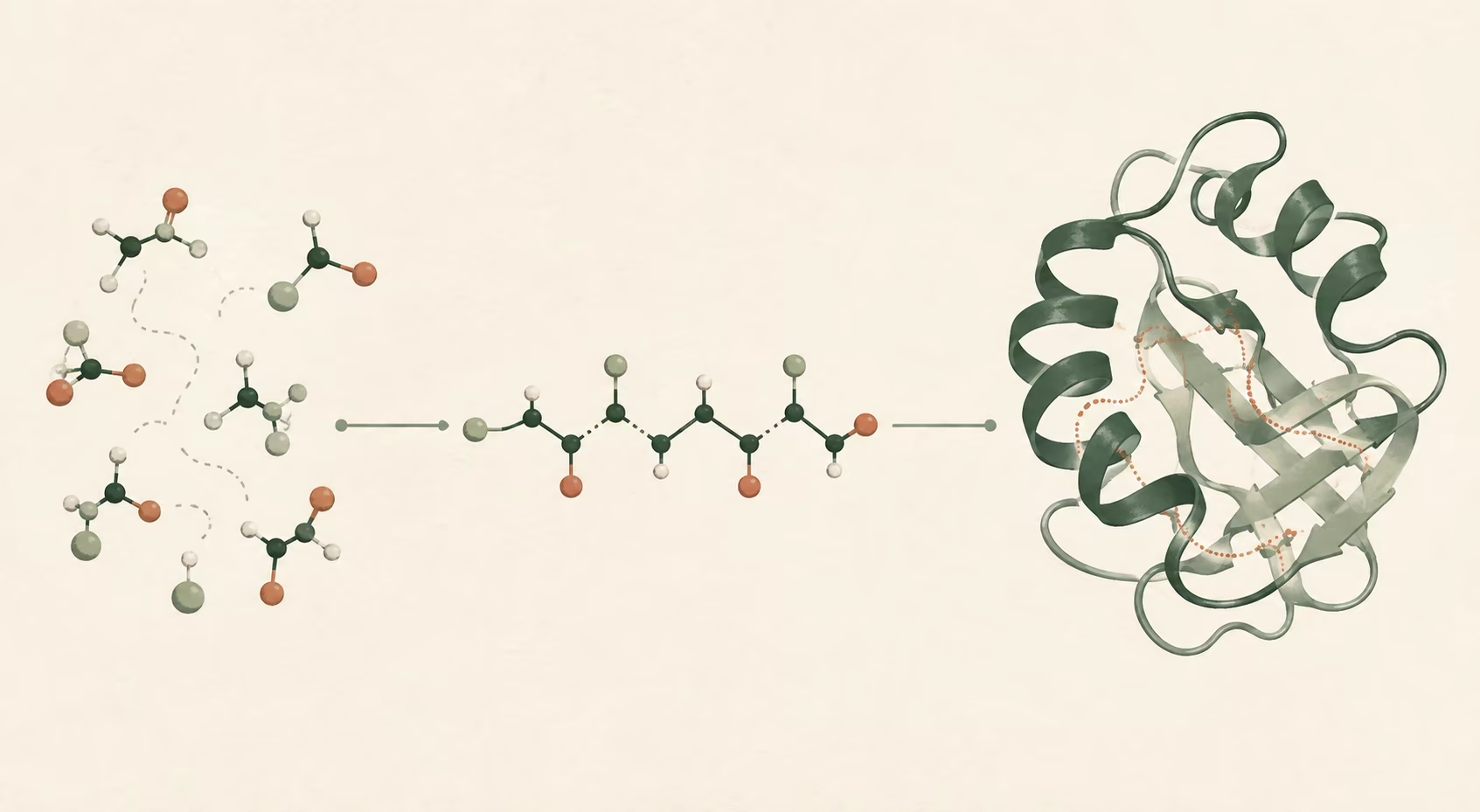
Amino acid
One building block in the chain.
Peptide
A shorter chain with a specific sequence.
Protein
A larger folded chain or set of chains.
Sequence matters. Two molecules can both be called peptides and still have very different functions, evidence, manufacturing requirements, and risk. That is why “Are peptides safe?” is too broad to answer without naming the exact compound and product.
You may encounter naturally occurring signaling peptides, approved medicines, compounded preparations, cosmetic ingredients, or research reagents. The category comes first because it determines which label, regulator, evidence, and questions apply.
Do not treat every peptide like the same product
Before searching for benefits or side effects, establish what is actually in front of you. Similar compound names do not make products interchangeable.
Approved prescription product
Approval applies to a specific product, formulation, and use. Start with the official prescribing information and clinician guidance.
How FDA approval works ↗Compounded preparation
Compounded drugs may serve a patient-specific need, but FDA does not approve them or review them before marketing for safety, effectiveness, or quality.
FDA on compounded drug risks ↗Research-use product
A “research-use only” label is not a human-use instruction. Marketing an unapproved drug for people bypasses FDA review of safety, effectiveness, and labeling.
FDA on unapproved drugs ↗Dietary or cosmetic product
Collagen peptides and peptide-containing cosmetics sit in different categories from medicines. Evaluate that product and the claim being made, not the shared word on the label.
Explore the peptide library ↗Catalog lookalikes can include non-peptides. A vial format or vendor category does not determine chemistry. 5-Amino-1MQ, SLU-PP-332, and MK-677 (ibutamoren) are small molecules, while NAD+ and NMN are not amino-acid chains. Check the exact compound rather than assuming everything listed beside a peptide is one.
Peptides are not steroids. They are different chemical families. Legality is a separate, product-specific question that depends on the compound, how it is sold, the intended use, and the rules that apply in your location or sport.
Start by naming the study type
“Research-backed” can mean anything from a cell experiment to multiple human trials. Match the evidence to the exact compound, formulation, route, population, outcome, and intended use before drawing a conclusion.
Product-specific regulatory record
Official label, approved use, manufacturer, and known warnings.
Randomized controlled human studies
Most useful when the studied product, people, outcome, and use match the claim.
Other human evidence
Observational studies and case reports can signal patterns but carry more uncertainty.
Animal or cell research
Helpful for mechanisms and hypotheses; it does not establish a human outcome.
Anecdote or marketing claim
Useful as a question to investigate; it cannot prove cause, benefit, safety, or product quality.
The ladder is a reading order, not an automatic verdict. A small early trial may be appropriate for an emerging question; it simply cannot carry the same certainty as a well-replicated body of human evidence. Watch for absolute language, surrogate outcomes, tiny samples, missing control groups, and claims that jump from a related molecule to the product being sold.
Know exactly what a COA can establish
Product documentation should be read as a chain of specific claims. A result is useful only if you know exactly what sample was tested, which lot it represents, when it was tested, who performed the test, and what the method can actually establish.

Can this record be tied to this product?
- Compound and product name
- Lot or batch number
- Test date and named laboratory
- Verified and reported result
What does the record not establish?
- Clinical effectiveness for a person
- Sterility, identity, or handling protocol tested
- Authenticity of every vial or future lot
- Regulatory approval or prescribing guidance
Match the document to the product and lot.
It helps to bundle related documents and compare identifying fields. A mismatched document is not an endorsement of the vendor, product, laboratory, or suitability for human use.
Went in blind by your first walkthrough? Read the product documentation guide.
A calculator checks inputs. It does not invent them.
Unit conversion can prevent arithmetic mistakes, but a polished result is still wrong when the starting information is wrong. Enter only values confirmed by the label, written instructions, prescriber, or dispensing pharmacy.
Your terms to keep separate
Stop before calculating if…
- The product or vial amount is uncertain
- The intended dose is not written down
- The liquid volume has not been specified
- The device scale is unfamiliar or does not match
Ask the prescriber or dispensing pharmacy to clarify before an instruction with a common outcome mismatch.